
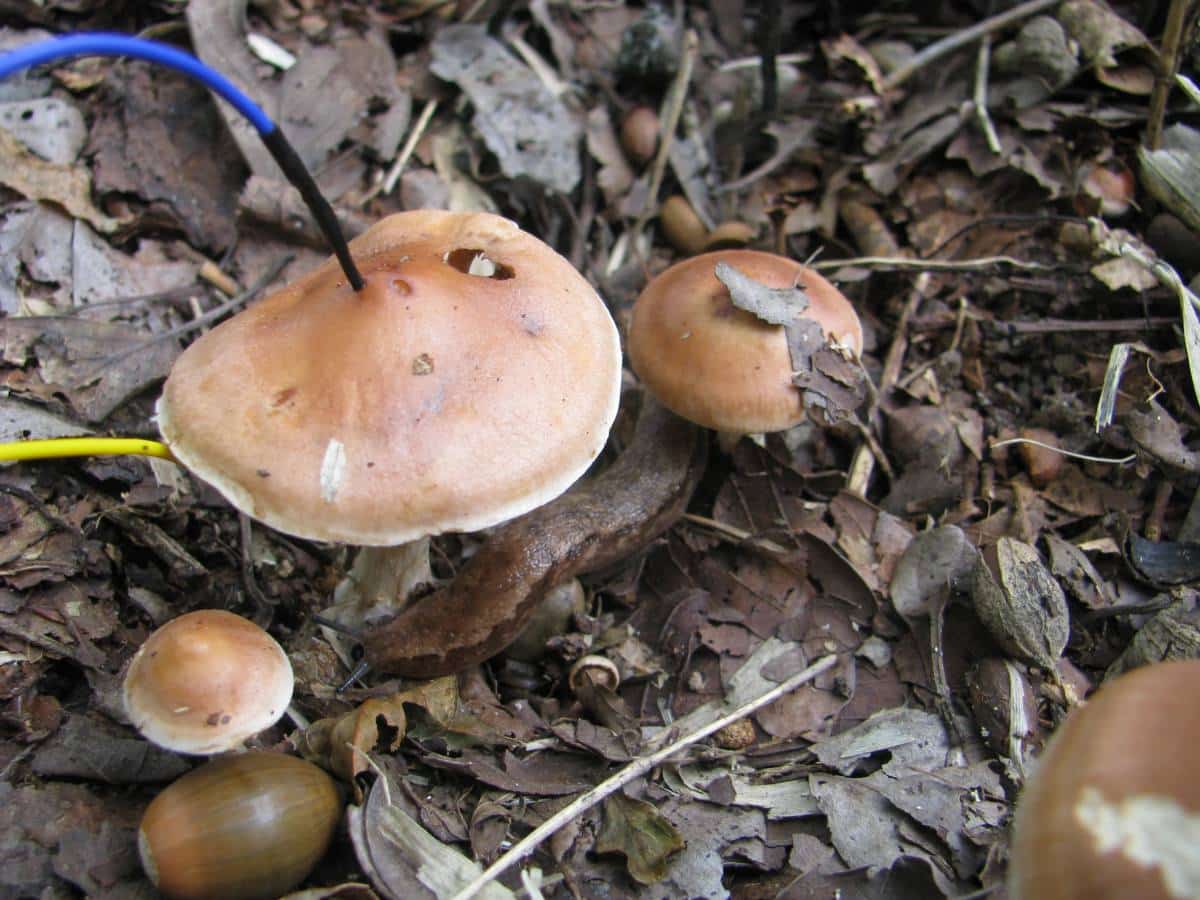
We are used to perceiving a forest merely as a collection of individual trees and shrubs with mushrooms popping up underneath after a good rain. But something much more complex and fascinating is hidden underground. A recent study by Japanese biologists, published in the scientific journal Scientific Reports and covered in detail by Naked Science, proves an astonishing fact. Fungi can actively communicate with each other using electrical impulses to form a fully functional communication network.
For a long time scientists could only guess the scale of this phenomenon. It was possible to record electrical micro-signals in a laboratory setting, but in the wild the process remained a mystery due to the hidden nature of the mycelium. To solve this problem Japanese ecologists turned an ordinary oak forest into a natural laboratory. They waited for the autumn growth of thirty-seven wild Hebeloma mushrooms and carefully inserted medical electrodes into their caps and stems. The equipment continuously recorded the potential difference over several days. It turned out that the underground network does not just exist, it works without any interruptions. The organisms are constantly sending electrical messages to each other, and the strength of this dialogue directly depends on the distance and their degree of kinship.
The most interesting part began when the researchers tested how the mycelium reacts to external stimuli. As soon as they locally watered the soil around one specific mushroom, its electrical potential instantly spiked. Within just half an hour the entire experimental network burst with an active flow of information. Signals rushed from the moistened area to its neighbors. Surprisingly, not only genetic relatives participated in this conversation. The researchers discovered a powerful information exchange even between entirely different species of fungi. Moreover, they found a kind of communication hub among them. One of the mushrooms took on the role of a router by sending the strongest and most directed impulses to the other network participants, even the distant ones.
These findings force us to look at the structure of forest ecosystems in a whole new way. The underground network serves as more than just a transport artery for pumping nutrients. It acts as a highly complex early warning system that allows different organisms to react lightning-fast to the local appearance of resources or environmental changes. The exact mechanisms of this connection are yet to be thoroughly decoded by biologists. Impulses might travel directly through the intertwined threads of the mycelium or via complex chemical reactions around neighboring colonies. One thing is absolutely certain: a living natural internet is functioning flawlessly right under our feet.
For a deeper dive into the details of this amazing experiment you can check out the full breakdown on the Naked Science portal (naked-science.ru) or explore the original scientific publication in the journal Scientific Reports.