
It’s 2026, and the world has gone completely biohacking and productivity mad. We’ve tried synthetic nootropics, microdosing everything under the sun, and complex vitamin stacks. But in the end, science is leading us back to nature.
If you follow neurobiology, you’ve probably noticed that conversations about brain health are increasingly revolving around mycology. The mushroom pharmacy turned out to be far more complex and intelligent than we previously thought. Forget ordinary stimulants that lend you energy today only to leave your nervous system depleted by evening. The modern approach is about the long game: creating new neural connections and protecting what we already have.
How Lion’s Mane is changing the rules of the game
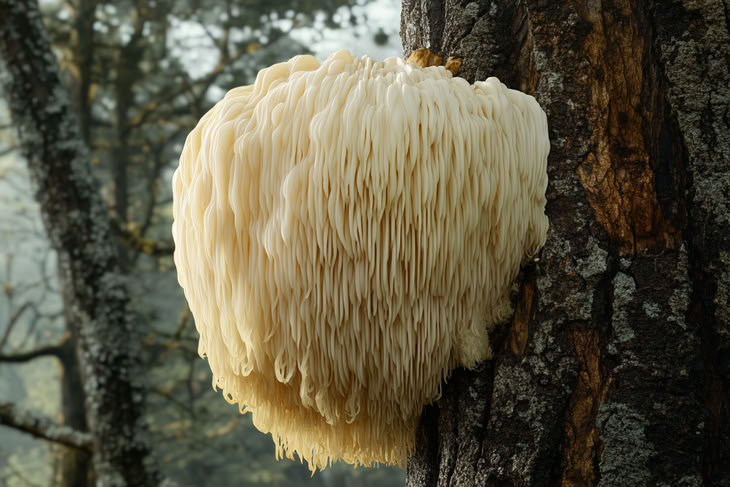
Among all natural nootropics, this mushroom holds a truly special place. Outwardly, it looks like a white, fluffy beard or a lion’s mane growing on tree trunks. For centuries, Buddhist monks brewed it to aid concentration during meditation, but today it’s more than just an element of traditional medicine. It is the subject of intense focus in the world’s top laboratories.
The magic of Lion’s Mane lies in two types of compounds. Hericenones are found in the mushroom’s fruiting body, while erinacines hide in the mycelium – its root system. These substances can do what most modern drugs cannot: they cross the blood-brain barrier directly and stimulate the production of nerve growth factor. Put simply, they force your brain to renew itself.
The secret to why it stays a top supplement for improving memory and focus
The supplement market is overcrowded, but Lion’s Mane isn’t losing ground. The secret to its popularity is that people actually feel the effect. It’s not some abstract benefit you have to wait years for. Those who start taking a high-quality extract regularly note that brain fog clears, thoughts become sharper, and the ability to maintain focus on complex tasks increases significantly.
It’s interesting to recall the story of Paul Stamets – the most famous mycologist of our time, whom you can easily recognize by his signature hat made from tinder fungus. Stamets has dedicated his life to studying fungi and spent years telling the academic community that we are catastrophically underestimating their potential. He was one of the first to actively promote Lion’s Mane as a means of brain protection, relying on his observations in the forests and early, cautious laboratory research. Many considered him an eccentric, but time has shown that this passionate man with the lumberjack beard was absolutely right.
How research into its impact on nerve cell recovery is reaching a new level
For a long time, skeptics argued that neurogenesis in adults was a process too slow and unresponsive to stimulation. But recent years have flipped the script. A real breakthrough was made by Professor Frederic Meunier’s team at the University of Queensland Brain Institute. Meunier is a passionate French neurophysiologist who moved to Australia to study how molecules work inside living cells. His passion for the nanoscale mechanics of the brain has led to stunning results.
Using super-resolution microscopy, Meunier’s team saw with their own eyes how the active substances in Lion’s Mane affect neurons. They isolated new, unique compounds like hericene A and proved that under their influence, the growth cones of nerve cells significantly increase. A growth cone is a kind of tentacle the neuron uses to feel its environment and look for a connection. Lion’s Mane makes these tentacles huge and active. Neurons begin to branch out and build new, dense networks, which leads directly to improved memory and cognitive flexibility.
Now, in 2026, we are seeing these laboratory miracles confirmed by serious clinical trials. Large-scale studies are currently wrapping up, where scientists are recording not just subjective improvements in mood and focus, but an objective increase in brain-derived neurotrophic factor levels in the blood.
We are on the threshold of a new era where maintaining mental clarity stops being an exhausting struggle against the symptoms of aging or fatigue. It is becoming a process of natural renewal, where nature itself suggests an elegant and effective solution.